Understanding the invisible engine of our world.
The modern supply chain is the greatest man-made wonder !!
recent posts
I am a supply chain professional with over two decades of experience designing, optimizing, and managing global operations. I blend industry knowledge with a passion for technology, exploring how AI and Machine Learning can make supply chains smarter, faster, and more sustainable.
-
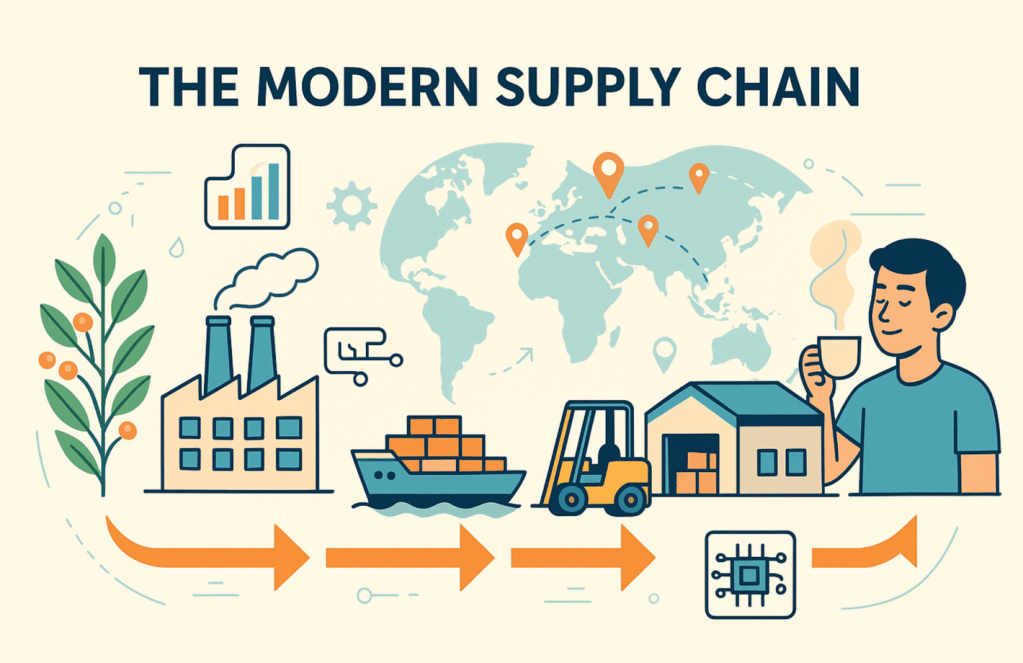
When we think of the “wonders” of the modern world, our minds often drift to skylines lit by glass towers, marvels of engineering like the International Space Station, or the vast networks of the internet. But there’s a quieter wonder — one that rarely makes headlines, yet keeps the world fed, clothed, connected, and alive.
It’s the modern supply chain.
Every day, billions of products — from fresh fruit to life-saving medicine — travel through an intricate, invisible web that spans continents. This web is powered by people, processes, and technology so seamlessly intertwined that most of us never notice it… until it breaks.
In a way, the modern supply chain is like oxygen:
- We don’t think about it when it’s there.
- We panic when it’s gone. (Remember the COVID days?)
The Coffee in Your Cup
Think of your morning coffee:
- Beans grown on the volcanic slopes of Guatemala.
- Bagged in jute sacks and trucked to the nearest inland port.
- Shipped across the Atlantic to roasting facilities in Italy.
- Roasted, blended, packaged for export, and shipped to your country.
- Distributed to supermarkets, cafés, and online retailers.
- Ground and brewed in your kitchen by a machine with its own complex manufacturing and supply chain.
- Sipped from a cup, most likely made in China.
The fact that all of this happens in time for you to enjoy it before your morning meeting is the result of precision choreography — farmers, transporters, warehouse operators, port managers, customs officers, planners, and AI algorithms all playing their part in perfect timing.
This is not an accident. It’s a symphony.
Behind the Scenes
The modern supply chain:
- Coordinates across dozens of countries and time zones.
- Balances cost, speed, and sustainability.
- Reacts to disruptions — a flood in Thailand, a port strike in Los Angeles, a container ship stuck in the Suez Canal blocking global trade, or rerouted voyages to avoid the Red Sea due to conflict — often without the end consumer ever knowing there was a problem.
Why I’m Writing This
I’ve spent my career inside this wonder — designing, implementing, troubleshooting, and now exploring how AI and Machine Learning can make it even smarter, faster, and more sustainable.
Understanding Supply Chains is my space to:
- Explain complex supply chain concepts in plain language.
- Show how AI/ML can solve real-world operational problems.
- Share working code so others can experiment and build.
- Celebrate the people and systems that make the supply chain possible.
The AI Advantage
If the supply chain is the greatest man-made wonder, then AI is like giving it a sixth sense — the ability to anticipate, adapt, and act with speed that human reflexes alone can’t match.
We’re just scratching the surface of what’s possible: from predicting demand with uncanny accuracy, to optimizing delivery routes in real time, to reducing carbon footprints without sacrificing service levels.
The pyramids of Giza, the Great Wall of China, and the Taj Mahal are all extraordinary feats of human effort. But none of them feed 8 billion people every single day, keep hospitals stocked with medicine, or make sure your laptop charger arrives before your battery dies.
That’s why I believe the modern supply chain deserves a place among humanity’s greatest wonders — and why I’m dedicating this space to exploring it.
 Understanding the invisible engine of our world.